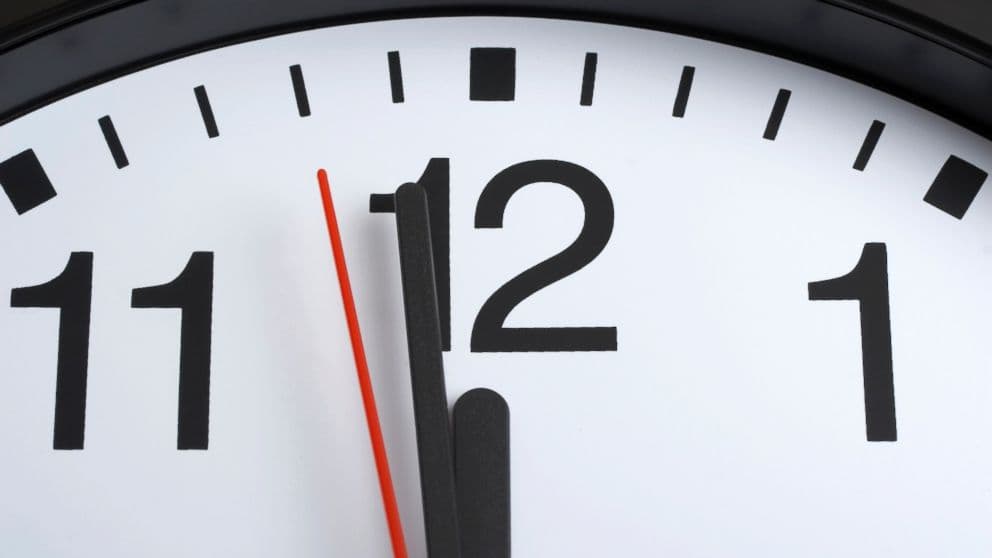
What is a second? A… second? 60 parts of a minute? For more than sixty years, what we mean by a second has remained virtually unchanged. While clocks accurately mark every second, this is often not enough for certain technologies or scientific experiments. Now, a group of researchers claims to have a method 100 times more accurate than cesium atomic clocks, which have been used since 1960 to measure the standard of time.
Atomic clocks are essential in many technologies to define precisely how some products and services work, such as GPS. They are also used in scientific research to analyze components or measure distances. They have hardly any deviations and it takes millions of years for an atomic clock to drift one second forward or backward. Now, they can be more precise.
A group of researchers at the Boulder Atomic Clock Optical Network (BACON) in the United States has published a new study discussing experiments they have done more accurately measure time. Using atomic clocks with atoms other than cesium and comparing their measurements, they have been able to determine the accuracy of up to 100 times higher.
New atomic clocks, the new standard
Atomic clocks use the frequency of a specific atomic transition as a stable time standard. As they explain, they compared three atomic clocks made with ytterbium atoms, with strontium atoms, and with a single electrically charged aluminum atom. These, in principle, allow higher frequencies than cesium atomic clocks, thus offering up to 100 times more precision.
Placing the clocks in different laboratories and 1.5 kilometers apart, they set about comparing the measurements they gave. The information was sent both by an open-air laser link and by fiber optics. With this, they were able to experience measurements up to 10 times more accurate than other clock comparisons.
Why? To be able to obtain even smaller time measurements and thus have an even more precise standard of what exact second measures. In addition to improving the definition of the second, better optical clock comparisons could benefit other branches of science. For example, they could be used to better understand how gravity affects time, to study dark matter, or for such “trivial” things as detecting changes in the Earth’s crust.
 New Technologies